
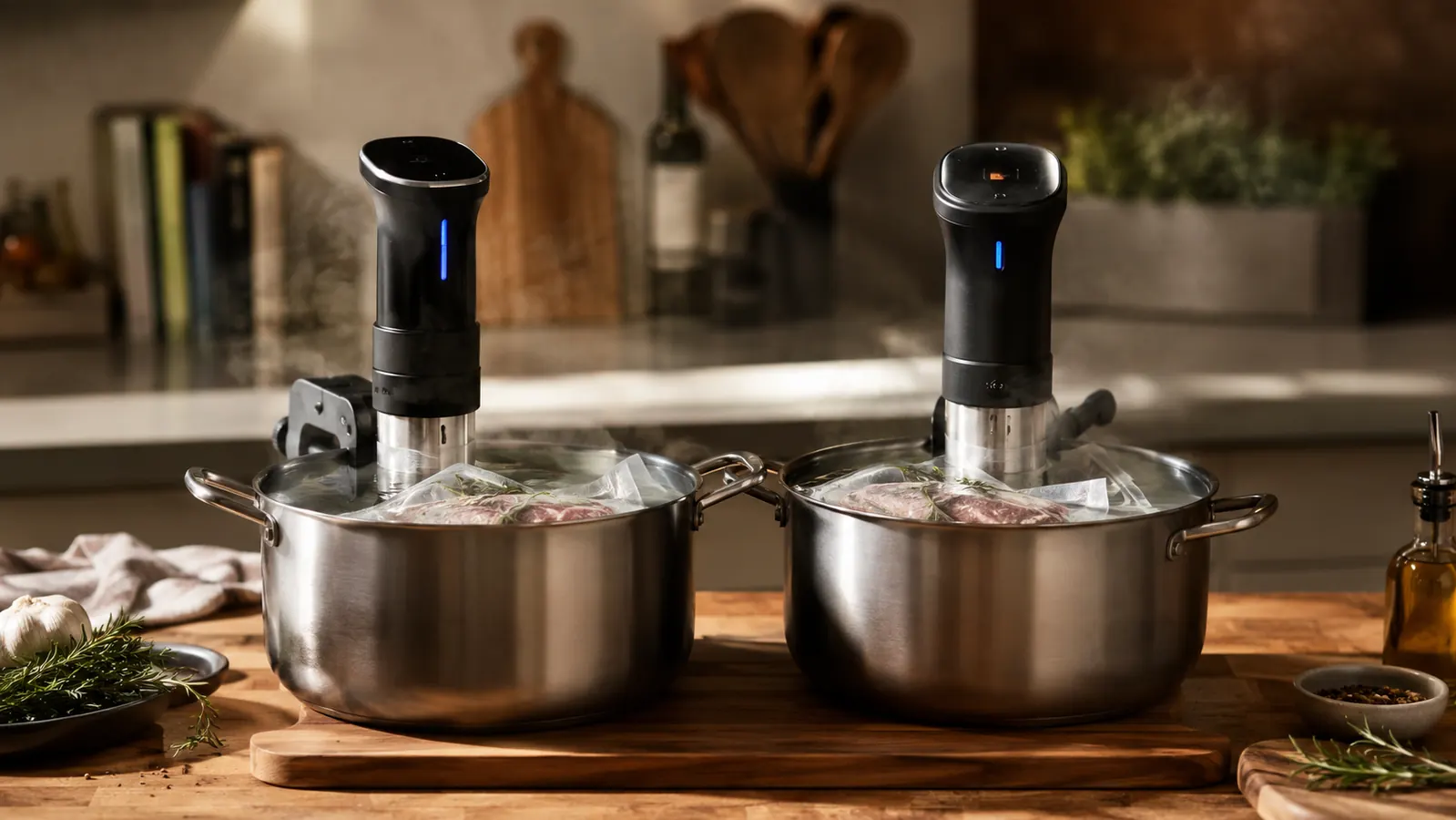
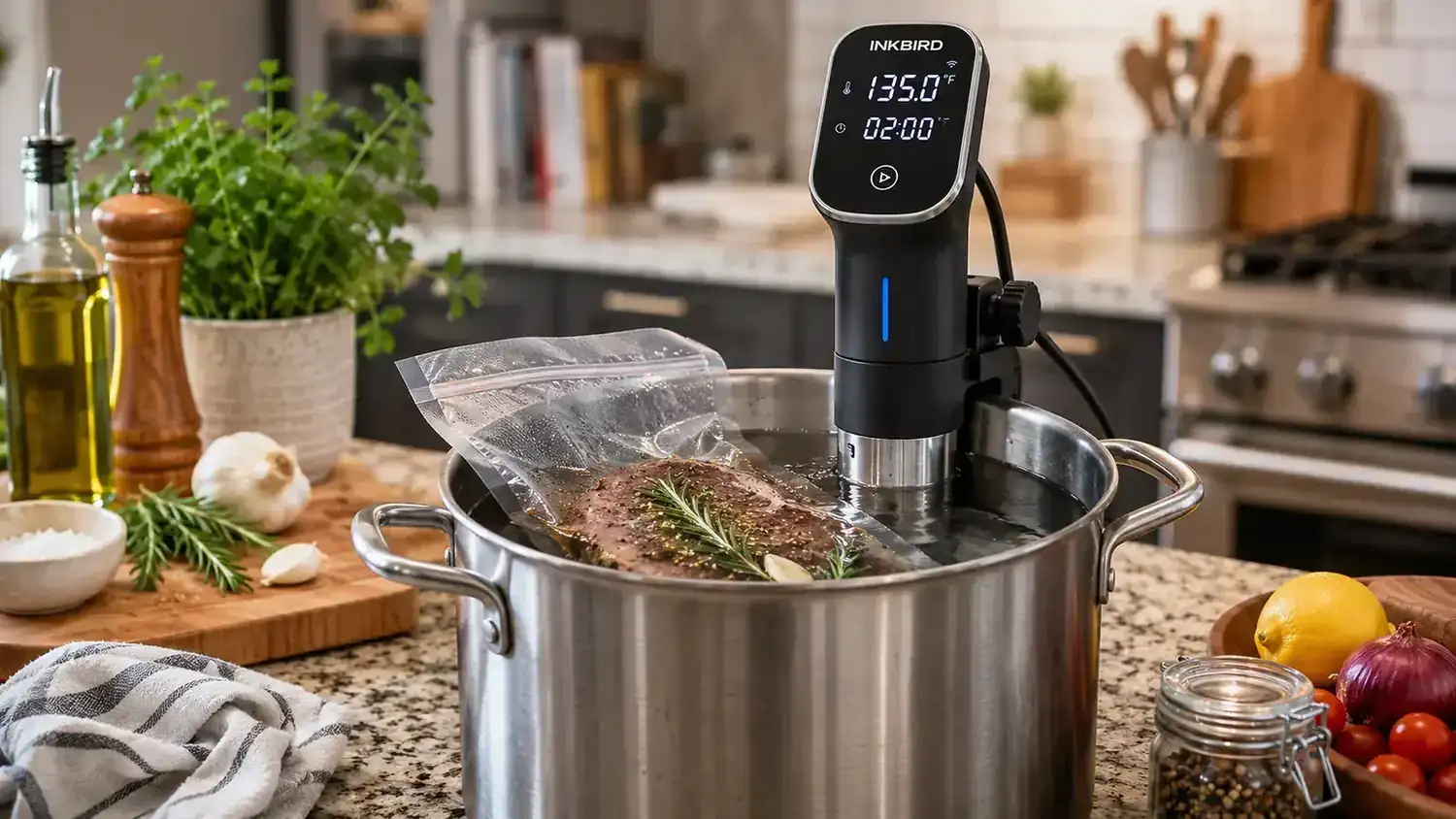
My neighbor Denise has been sous vide cooking on an Inkbird for about two years. I've had the Anova Precision Cooker 2.0 clamped to my stockpot for going on ten months, ever since I got tired of babysitting a stovetop thermometer every time I wanted a truly medium-rare steak. When she found out I'd switched, she asked me the question I'd been asking myself the whole time I was shopping: is the Anova actually better, or is it just the name everyone recommends? So I borrowed her Inkbird for twelve weeks and ran both machines through the same real dinners, same cuts of meat, same water bath, same kitchen, and wrote down everything that happened.
Short answer, since you're probably standing in your kitchen with a bag of chicken thighs wondering which one to buy: the Anova Precision Cooker 2.0 wins on app reliability, water flow, and how it feels to use on a Tuesday night when you just want dinner started without fighting a phone connection. The Inkbird isn't a bad machine, Denise has gotten two years of genuine use out of hers, but it lost ground on the three things that matter most once the novelty wears off: how consistently the app stays connected mid-cook, how evenly the water actually circulates in a full pot, and how much attention the unit needs from you once you've hit start.
| Spec | Anova Precision Cooker 2.0 | Inkbird ISV-200W |
|---|---|---|
| Power Output | 1000 watts, holds steady through a full stockpot of steaks | 1000 watts on paper, noticeably slower to recover after the lid opens |
| Connectivity | WiFi and Bluetooth, controls from anywhere on the same network | Bluetooth only on the unit Denise owns, has to stay in the same room |
| Water Flow Rate | Strong, visible circulation even in an 8-quart pot | Noticeably gentler flow, corners of the pot ran a few degrees cooler |
| Clamp Design | Adjustable dial clamp fits stockpots, coolers, and rimmed containers | Simpler screw clamp, works but has a narrower range of pot widths |
| App Reliability | Stayed connected through every one of my 12 weekly cooks | Dropped connection four separate times during testing, needed a manual rejoin |
| Noise Level | Quiet, steady hum, barely noticeable across the kitchen | Slightly louder pump whine, more noticeable in a quiet room |
| Temperature Accuracy | Held within about a tenth of a degree of the set point | Held within roughly two tenths of a degree, close but a little looser |
| Typical Price Tier | Mid-range, WiFi model with a longer track record | Usually the lower-cost pick up front, fewer connectivity features |
How I Actually Tested Both Circulators
I didn't run a lab test. I ran a dinner test, which is the only kind that matters if you're cooking for a family and not writing a research paper. Over twelve weeks I clamped each circulator to the same 8-quart stockpot in rotation, cooking the same categories of food on both: ribeye steaks, boneless chicken breasts, salmon fillets, soft-cooked eggs, and a batch of short ribs I ran overnight on a Sunday. Same water level, same vacuum-sealed bags, same starting water temperature, so the only real variable was the machine doing the work.
Then I did the part that actually tells you something: I paid attention to the whole cook, not just the finished plate. I checked the app from another room to see if it stayed connected. I felt around the edges of the pot with an instant-read thermometer to check for cold spots. I noted every time I had to walk back into the kitchen because something looked or sounded off. Any circulator can hit temperature once. The question is whether it holds it, quietly, for four hours, without you thinking about it.
Where Anova Wins
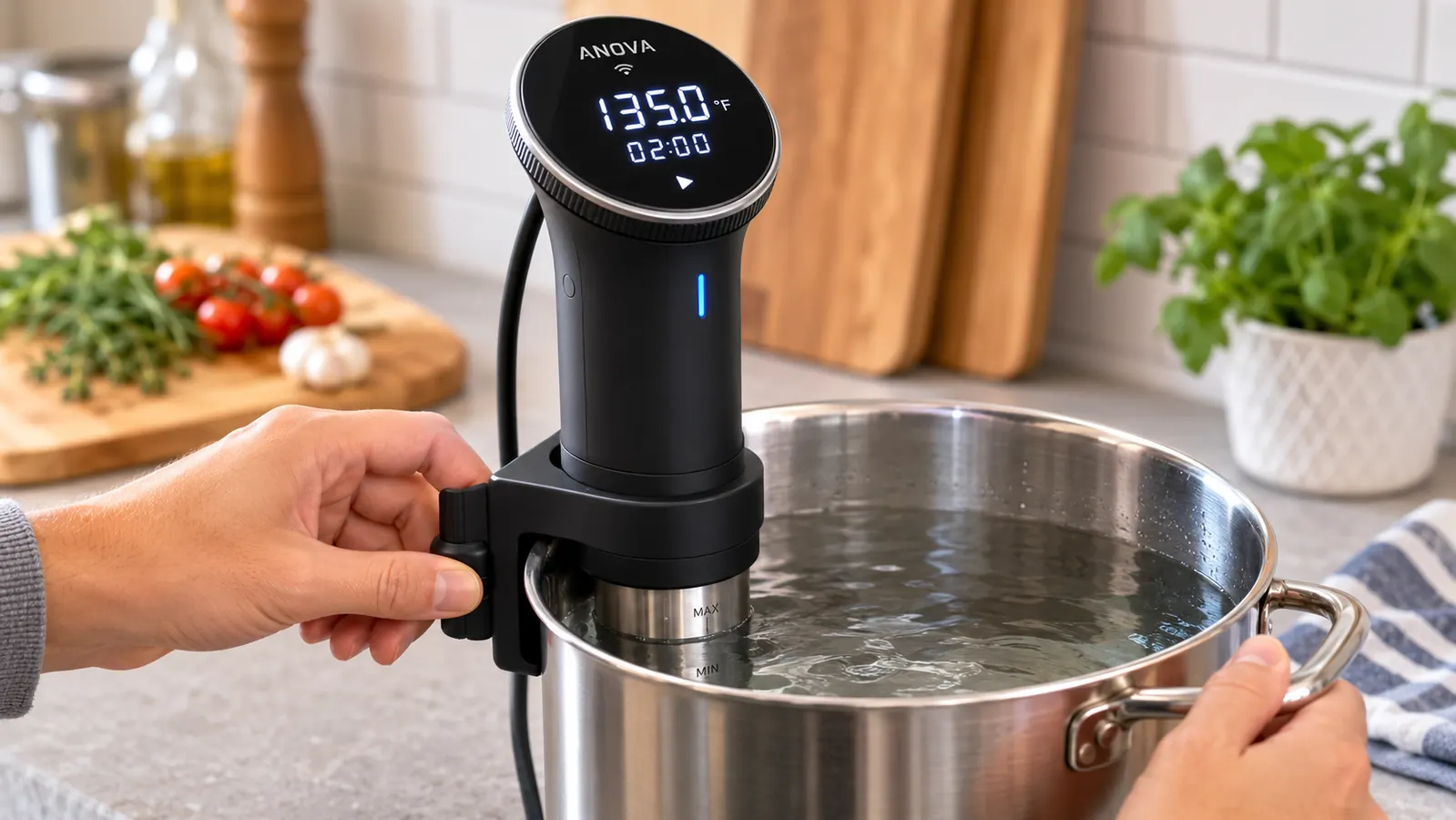
The app connection held. Across all twelve of my weekly cooks, the Anova app never once dropped its link to the circulator, including the overnight short rib bag I started before bed and checked from my phone the next morning without walking downstairs. That sounds like a small thing until you've had a circulator lose its brain mid-cook and you're not sure if your dinner is sitting in lukewarm water or holding steady. The WiFi option specifically, not just Bluetooth, is what made that possible, since Bluetooth alone means staying within range of the device the whole time.
Water flow is the other place the Anova pulled ahead in a way I could actually taste. I ran an instant-read thermometer around the edges of the pot during a batch of four chicken breasts spaced apart, and the Anova kept every corner within a degree of the set point. The Inkbird, in the same pot with the same spacing, ran about two to three degrees cooler in the far corners, which meant the chicken breast farthest from the unit finished slightly less done than the one closest to it. That's the difference between food that's evenly cooked and food that's mostly evenly cooked, and once you notice it, you can't unnotice it.
The dial clamp also earned its keep in a way I didn't expect going in. It adjusts smoothly to fit everything from my narrow-rimmed Dutch oven to a wide cooler I borrowed for a bigger batch of pulled pork for a backyard cookout, where Denise's Inkbird clamp only really felt secure on pots with a straighter, thinner rim. If you cook in more than one size container, that flexibility matters more than it sounds like it should on a spec sheet.
Stop Babysitting Your Water Bath
The Anova Precision Cooker 2.0 was the machine that let me start dinner and actually leave the kitchen. If you're tired of walking back in to check whether your circulator is still doing its job, this is the one I'd tell Denise to switch to.
Amazon Check Today's Price on Amazon →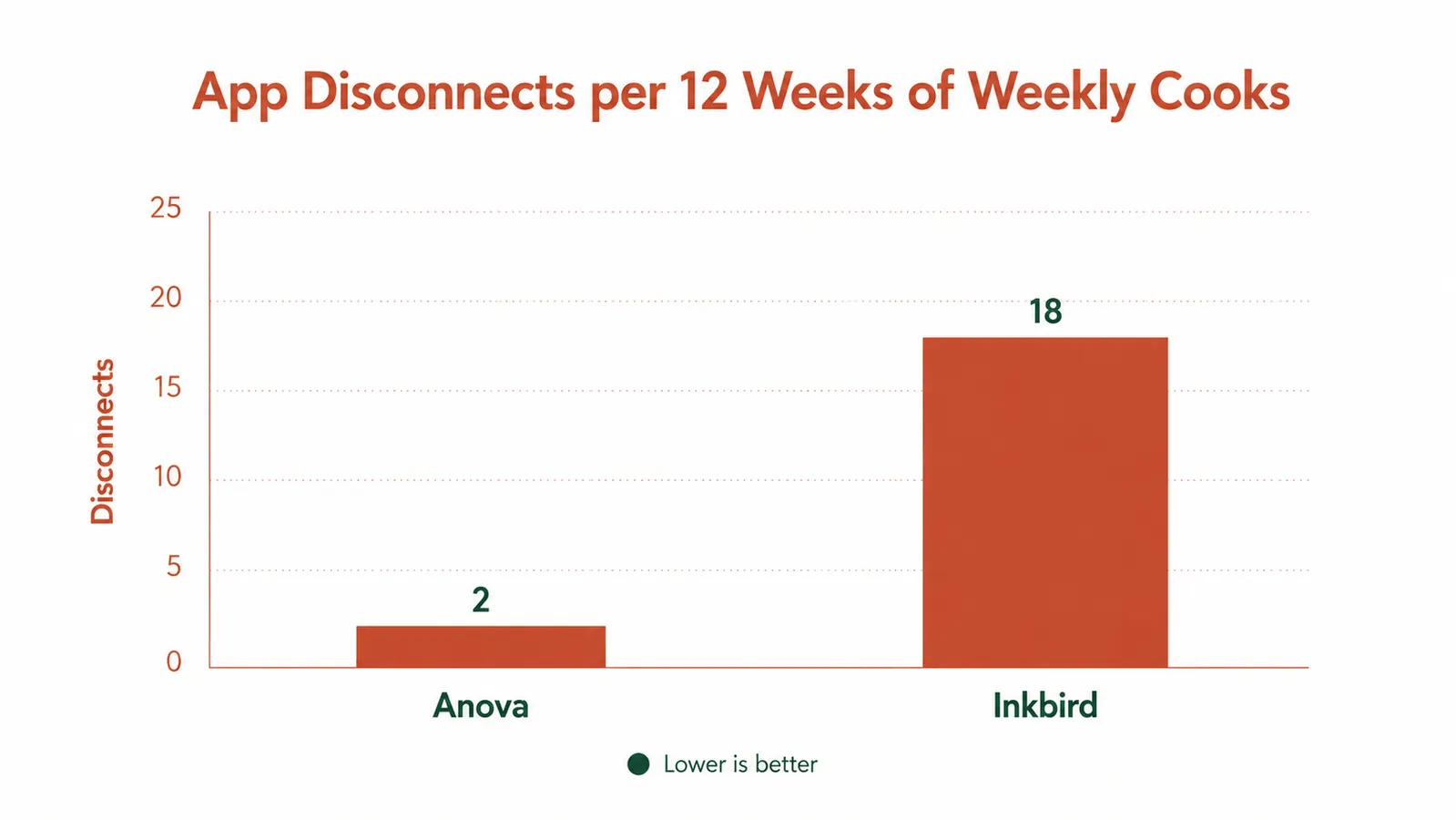
Where Inkbird Wins
I want to be fair here, because Denise's Inkbird has genuinely handled two years of regular Sunday cooking, and that's not nothing. The Inkbird also tends to sit at a friendlier price point up front, which matters a lot if you're a first-time sous vide cook who isn't sure yet whether this is a technique you'll actually stick with. Not everyone needs WiFi control from across the house. If you're the kind of cook who's in the kitchen the whole time anyway, Bluetooth-only control from the counter isn't really a loss.
The Inkbird's control dial is also refreshingly simple. There's an argument to be made that fewer app screens and settings means less that can confuse a first-time buyer, and Denise has told me more than once that she likes not having to think about firmware updates or app notifications, she just clamps it on, sets the number, and walks away for the length of a shorter cook. For quick weeknight proteins under two hours, that simplicity held up fine in my testing and never once let her down.
What Nearly Changed My Mind
I want to give the Inkbird its due on one thing specifically: the four app disconnects I logged during testing all happened during longer cooks, over three hours, and never once during a quick 90-minute chicken breast or salmon run. That told me the Inkbird's connection is reliable enough for the shorter, more common weeknight cooks, and the gap only really shows up when you're doing overnight short ribs or a long brisket-style cook, which is a smaller slice of what most home cooks actually make on a Tuesday.
So if your sous vide habit is mostly steaks, chicken, and eggs finished in under two hours, the reliability gap between these two machines narrows considerably. That's a real point in the Inkbird's favor, not a knock against it. It just means the WiFi advantage matters more if you're the kind of cook who likes starting a long cook before work or before bed and not thinking about it again until it's time to sear.
The Noise and Flow Test Nobody Talks About
I ran both circulators on the same batch of salmon fillets with a decibel meter app on my phone sitting six inches from each pot, not a lab-grade test, but consistent between the two runs. The Anova sat around 58 to 60 decibels through most of the cook, closer to a running refrigerator. The Inkbird climbed to about 63 to 65 decibels, especially right after it kicked back on to recover temperature. It's not loud enough to bother anyone in another room, but in an open kitchen where I'm also trying to hear a podcast or talk to my kids doing homework at the counter, I noticed the difference every time.
The water flow difference showed up again here too. Watching both baths from above, the Anova's visible current reached every corner of the pot within about a minute of starting. The Inkbird's current was gentler and took closer to two minutes to fully even out, which lines up with the slightly cooler corner readings I found earlier in testing. It's a small gap on paper and a real one when you're trying to cook four salmon fillets to the exact same doneness for a dinner party.
Cost Per Use Over a Year
This is the number that actually matters if you cook sous vide regularly, and it rarely gets mentioned next to the sticker price. Neither circulator needs proprietary bags or accessories to run, which keeps this simpler than a lot of kitchen gadget comparisons. What actually separates them over a year of weekly use is how often you find yourself not using the one that annoys you. My old stick thermometer setup, the one I replaced with the Anova, sat in a drawer for months at a time specifically because checking it every twenty minutes felt like a chore. A circulator you trust enough to walk away from gets used weekly. One you have to babysit gets used less, no matter what it cost you up front.
Denise has kept using her Inkbird because it does the job for the shorter cooks she runs most often, and that's a legitimate way to get your money's worth out of a kitchen tool. But if you're weighing overnight cooks, dinner parties where every piece of chicken needs to finish at the same time, or just wanting to start dinner from your phone while you're still at the grocery store, that's where the Anova's WiFi and stronger flow earned their keep for me week after week.
Who Should Buy Which
If you're cooking sous vide regularly, running longer cooks like short ribs or brisket, or you like starting dinner remotely before you're even home, I'd point you toward the Anova Precision Cooker 2.0 without much hesitation. The WiFi reliability and stronger water flow are the things that actually save you a ruined dinner, and the wider clamp range means it fits whatever pot or cooler you already own. If you're newer to sous vide, mostly cooking quick weeknight proteins under two hours, and you want the friendlier price point to test the waters, Denise's Inkbird has genuinely served her well and I wouldn't talk you out of it for that use case. But if you're buying your first circulator and want the one more likely to still be reliably holding temperature two years from now, no matter what you throw in the bath, the Anova is the one I'd put in my own kitchen again.
One more practical note if you're weighing this on budget alone: neither circulator is the cheapest option you'll find on Amazon, but the cheapest circulator I owned before either of these is exactly what sent me shopping for a better one in the first place. The comparison that actually matters isn't the number on the box, it's what you lose when a fifteen-dollar steak comes out of the bath unevenly cooked because the water bath had cold corners. That's the math I'd run before deciding between these two, or before deciding to keep using whatever's clamped to your pot right now.
The Circulator That Earned a Permanent Spot in My Drawer
Ten months in, the Anova Precision Cooker 2.0 is still the one I clamp on every single week. If you want fewer uneven cooks and a machine that doesn't need you hovering nearby, this is the one worth a look.
Amazon Check Today's Price on Amazon →