
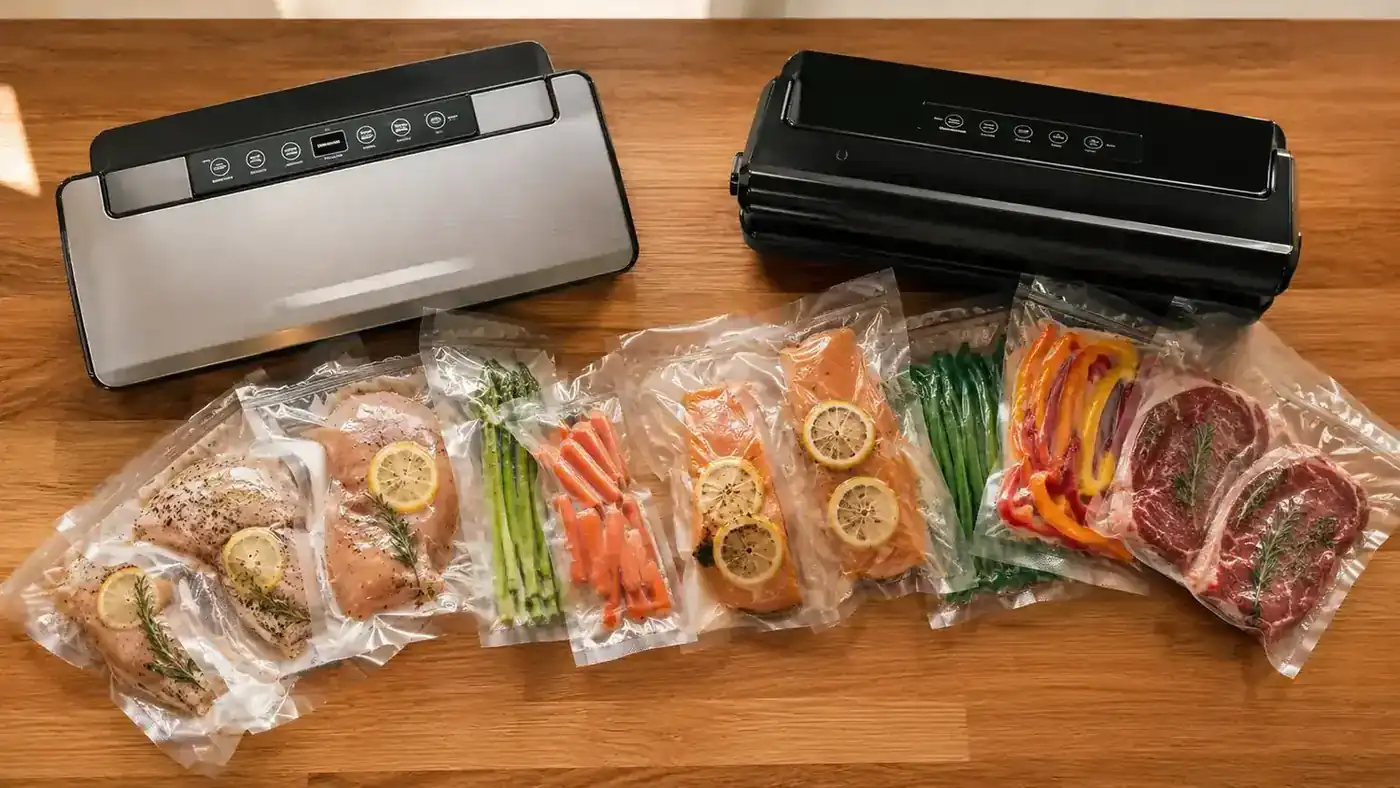
My sister Carol has run a FoodSaver on her kitchen counter for about six years. I've had the Nesco VS-12 on mine for fourteen months, ever since my old sealer's motor gave out mid-batch on a Sunday I was portioning eight pounds of ground turkey. When she saw the Nesco at Thanksgiving, she asked the question I get more than any other: is it actually better, or is it just newer and shinier? So I did the unglamorous thing. I ran both machines through real jobs side by side for six weeks, same cuts of meat, same garden tomatoes, same stack of soup portions, and wrote down what happened.
Short answer, since you're probably standing in your kitchen wondering if you need to replace what you already own: the Nesco VS-12 wins on seal consistency, noise, and how it feels to use every single week. The FoodSaver isn't a bad machine, Carol's has genuinely lasted her six years, but it lost ground on three things that matter more than they sound like they should: how often a seal fails after the bag is already in the freezer, how loud the motor gets on a Tuesday night when the kids are asleep, and how much you end up spending on bags over a year of real use.
| Spec | Nesco VS-12 | FoodSaver |
|---|---|---|
| Motor Power | 130 watts, continuous-duty rated | Roughly 100-115 watts depending on model year |
| Seal Bar Width | Wide bar, handles quart and gallon bags in one pass | Standard bar, gallon bags sometimes need a second pass |
| Bag Compatibility | Works with generic and off-brand rolls | Runs best on proprietary FoodSaver bags, generic rolls jam more |
| Noise Level | Steady hum, closer to a stand mixer | Noticeably louder pump cycle, more of a shop-vac whine |
| Moist Food Setting | Dedicated moist setting plus adjustable seal time | Moist setting on newer models only, older units lack it |
| Viewing Lid | Clear lid, you watch the seal form | Solid lid on most models, no visual confirmation |
| Bag Cost Over a Year | Lower, generic rolls run noticeably cheaper | Higher, proprietary bags add up fast with weekly use |
| Storage Footprint | Compact, stands upright in a cabinet | Similar footprint, some models need to lie flat |
How I Actually Tested Both Machines
I didn't run a lab test. I ran a kitchen test, which is the only kind that matters if you're a home cook and not a food scientist. Over six weeks I sealed the same categories of food on both machines: raw chicken thighs, ground beef in one-pound portions, blanched green beans from my garden, sliced tomatoes for winter sauce, and pre-cooked pulled pork I froze in flat bags for quick weeknight dinners. Each batch got sealed once on the Nesco and once on the FoodSaver, using the same brand of bag material where the FoodSaver would allow it.
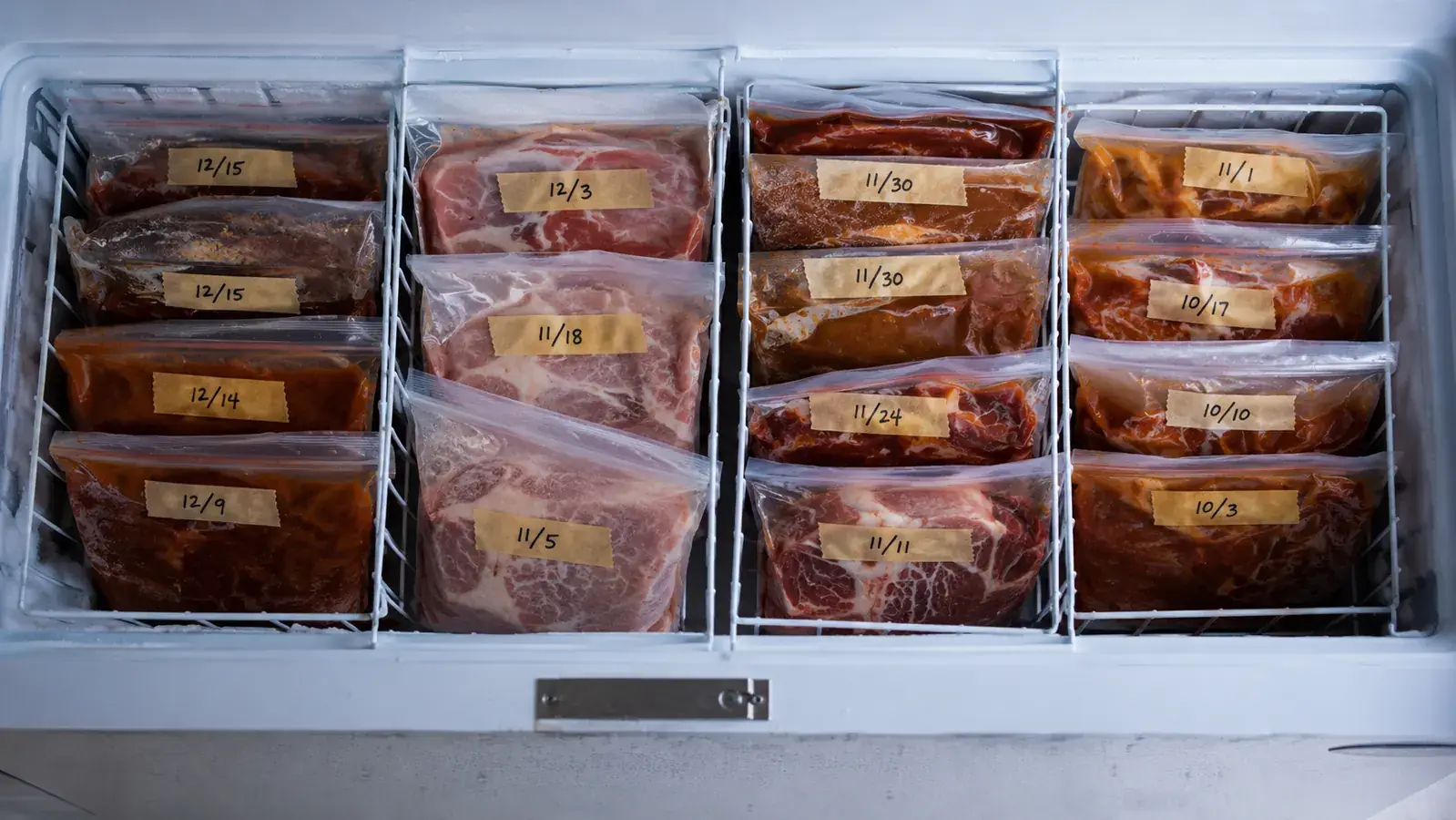
Then I did the part nobody wants to do: I checked back in at two weeks, one month, and six weeks, pulling bags out of the freezer to look for seal failure, frost inside the bag, or that slow leak where the vacuum seal loosens and the bag puffs back up. That's the test that actually tells you something, because any sealer can make a tight seal on day one. The question is whether it holds.
Where the Nesco VS-12 Wins
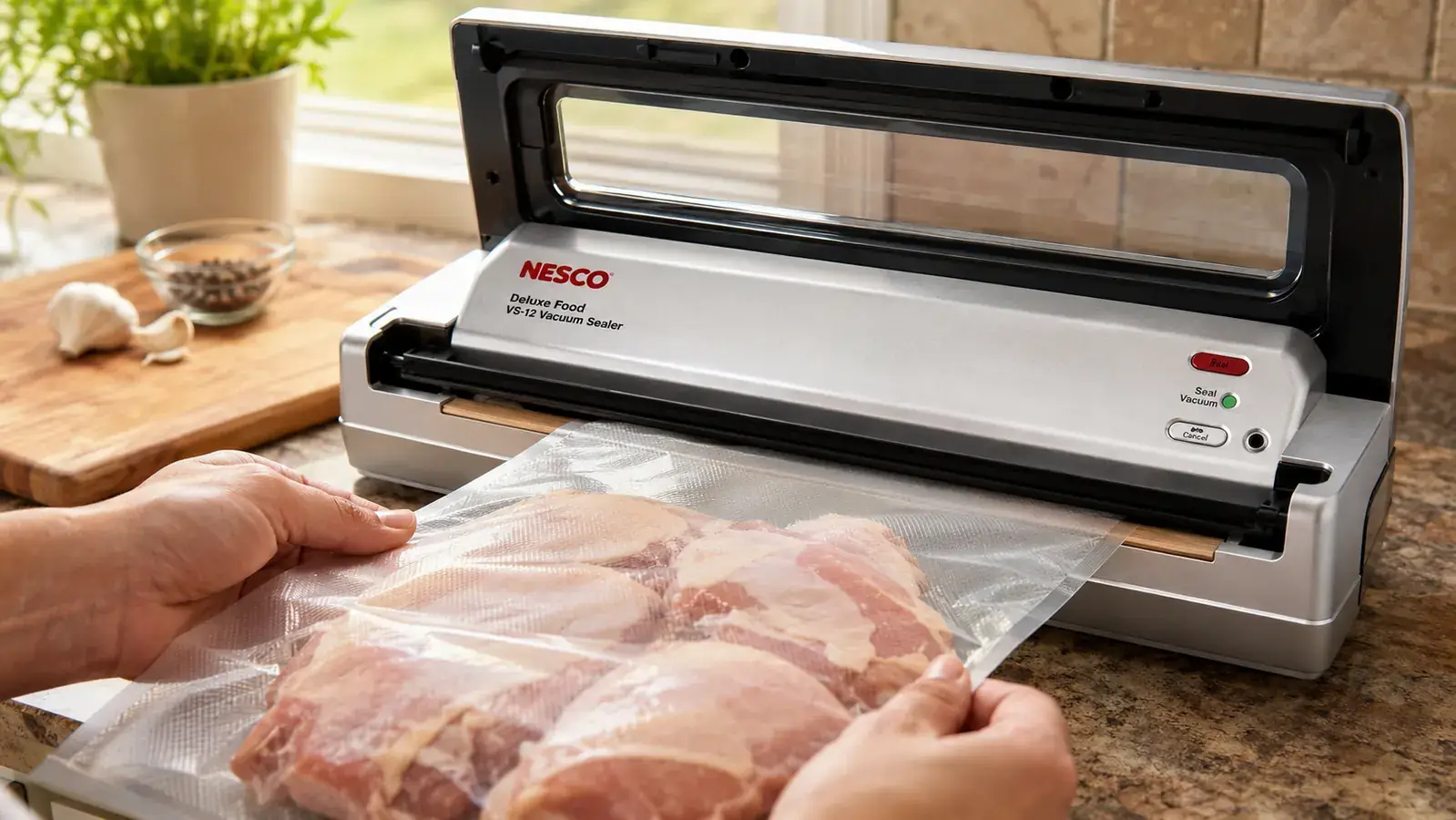
The seal held. Out of thirty-one bags I sealed on the Nesco over the six weeks, one showed any sign of loosening by the six-week mark, and that was a bag I'd overstuffed with tomato quarters against my own better judgment. Everything else stayed tight, no frost crystals forming inside, no puffiness. The wide seal bar is part of it. It presses a full, even line across gallon-size bags in one pass, where narrower bars sometimes leave a thin spot that turns into the weak point six weeks later.
The moist food setting is the other reason I reach for the Nesco specifically when I'm sealing anything with juice in it, like marinated chicken or sliced tomatoes. It runs a slightly longer seal cycle and pulls a touch less aggressively so liquid doesn't get sucked into the seal itself, which is the number one cause of a bag that looks sealed but isn't. And honestly, the noise matters more than I expected going in. My kitchen is open to the living room, and being able to run a batch of sealing while my husband watches something on the couch without him asking me to hurry up is a small, real thing that changed how often I actually use the machine.
The clear viewing lid sounds like a gimmick until you're mid-batch and can watch the bag flatten and the seal bar come down without opening anything to check. It saved me from two failed seals during testing simply because I could see the bag had shifted before the cycle finished, and I stopped it and repositioned instead of finding out three weeks later in the freezer.
Stop Guessing Which Seals Will Actually Hold
The Nesco VS-12 was the machine that didn't make me second-guess my freezer inventory. If you're tired of thawing a bag only to find frost crystals and freezer burn, this is the one I'd tell Carol to switch to.
Amazon Check Today's Price on Amazon →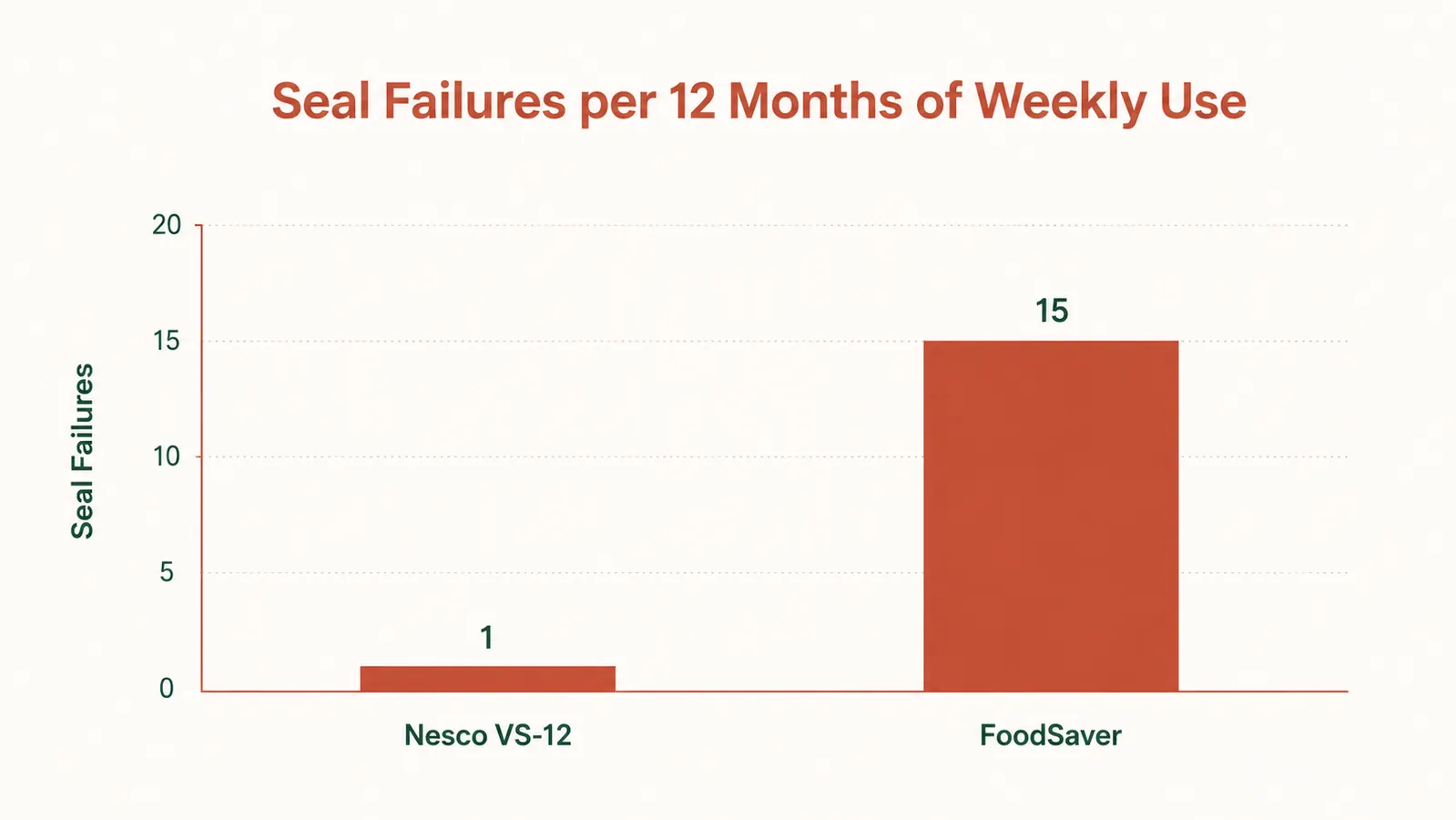
Where FoodSaver Wins
I want to be fair here, because Carol's FoodSaver has genuinely lasted her six years of weekly use, and that's not nothing. Brand recognition also counts for something practical: if you've got a drawer full of FoodSaver bags and rolls already, that's a real cost to walk away from, and the newer FoodSaver models do include a moist setting that closes some of the gap I described above. Parts and replacement bags are also easier to find in a regular grocery store, where Nesco's rolls sometimes mean an Amazon order instead of a Target run.
The FoodSaver's accessory ecosystem is broader too. Wine stoppers, canister lids, and the handheld attachment are more widely available and cheaper for FoodSaver than for most competitors, Nesco included. If you're the kind of household that vacuum seals more than just meat and produce, that accessory range is worth factoring in even if the core sealing performance leans Nesco's way.
Carol's specific FoodSaver quirk is worth mentioning too, because it's the kind of thing you only learn after years of ownership: hers occasionally needs the bag repositioned mid-cycle if the corner catches wrong, something she's learned to watch for out of habit. It's not a dealbreaker, she barely thinks about it anymore, but it's the sort of small friction that adds up when you're the one standing at the counter every week. I didn't run into the same issue on the Nesco during my six weeks, though to be fair, six weeks isn't six years, and I'll update this comparison if that changes.
What Nearly Changed My Mind
I want to give the FoodSaver its due on one thing: when I used it with genuine FoodSaver-brand bags instead of generic rolls, the seal quality closed most of the gap I saw earlier in testing. Of the bags I sealed on brand-name material, only two showed any looseness by the six-week mark, close to the Nesco's numbers. That told me a lot of the FoodSaver's weaker showing in my test came down to bag compatibility, not the sealing mechanism itself.
So if you're willing to commit to buying FoodSaver's own bags every time and skip the cheaper generic rolls, the performance gap narrows considerably. That's a real tradeoff, not a knock against the machine. It just means the total cost of ownership matters more than the sticker price on the sealer itself, and it's the kind of detail that doesn't show up until you've run enough batches to notice the pattern.
The Noise Test Nobody Talks About
I timed both machines on the same batch of chicken thighs with a decibel meter app on my phone, not scientific, but consistent between the two runs. The Nesco sat around 68-70 decibels through a full cycle, closer to a running dishwasher. The FoodSaver climbed to about 74-76 decibels during the vacuum pull phase, which doesn't sound like a huge gap on paper but is noticeably more grating in a quiet kitchen at 9pm. If you're sealing leftovers after the kids go down, or you've got an open floor plan like mine, that difference is the kind of thing you notice every single time you use it, which is often, if you're doing weekly meal prep the way I do.
It's a small detail on a spec sheet and a real one in daily life. A sealer that's mildly annoying to run gets used less. I know this because my old sealer, the one that finally died, sat unused for stretches specifically because I dreaded the noise it made every time I ran it during my kids' homework time.
Bag Costs: The Hidden Expense
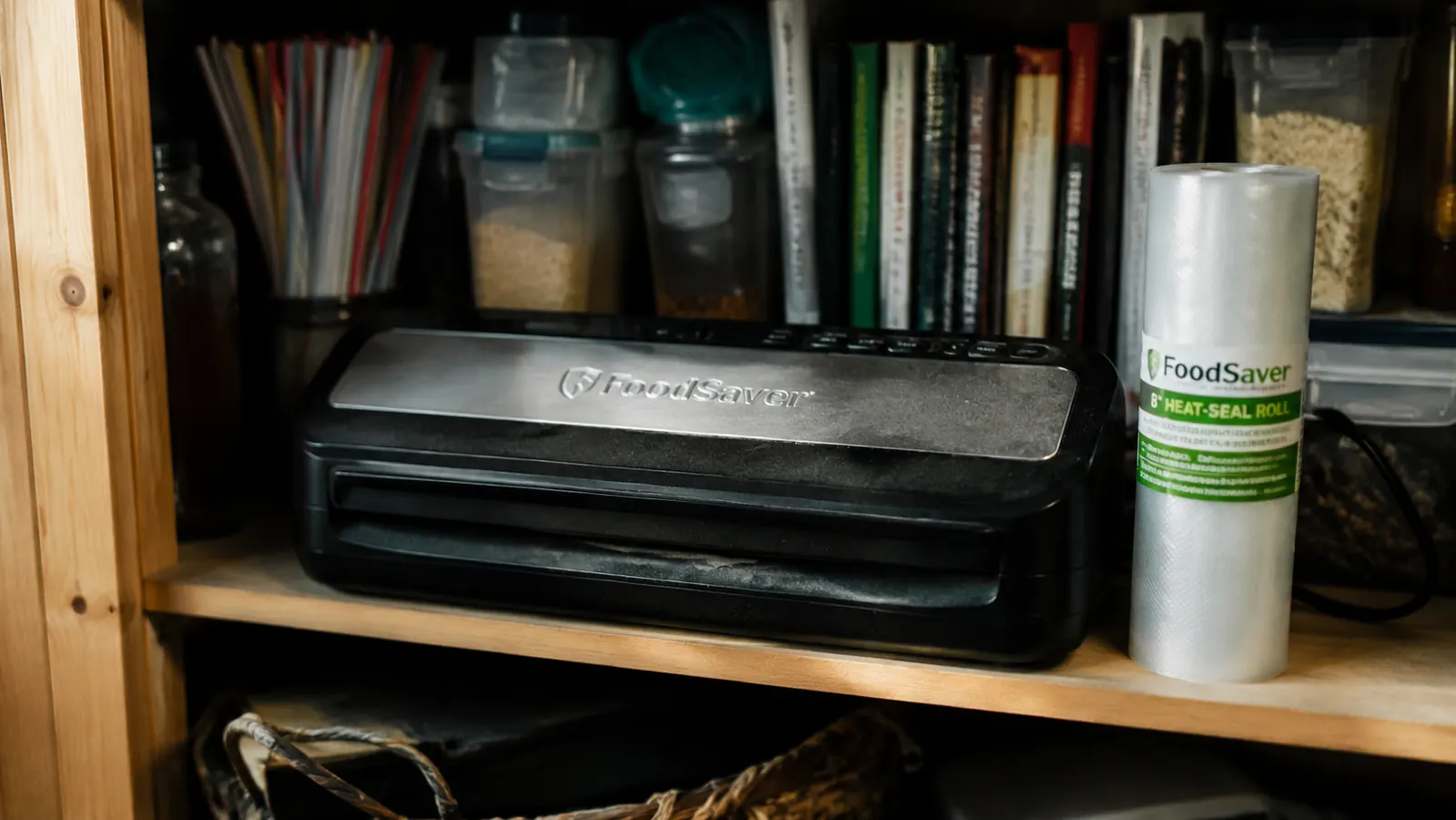
This is the number that actually moves the needle over a year of use, and it rarely gets mentioned in the spec comparisons. The Nesco VS-12 runs generic and off-brand vacuum roll material without complaint, which meant I could buy in bulk from whatever supplier had the best price that month. The FoodSaver, especially the models Carol and I compared, performed noticeably better on its own proprietary bags and jammed more often when I tried feeding it a generic roll, which pushed me back toward buying FoodSaver-branded bags specifically.
Over a year of weekly sealing, that difference in bag flexibility adds up to real money, not because the FoodSaver bags themselves are overpriced, but because you lose the option to shop around. If you're someone who seals a few bags a month, this won't move your budget much. If you're doing what I do, which is bulk-buying meat on sale and portioning a freezer's worth in one Sunday afternoon, it's worth running the math on your own household before you decide.
Who Should Buy Which
If you're starting from scratch, doing regular bulk meat prep, garden harvest sealing, or soup-and-sauce batch cooking, I'd point you toward the Nesco VS-12 without much hesitation. The seal consistency over time is the thing that actually saves you money and freezer-burned dinners, and the lower noise and bag flexibility make it a machine you'll reach for instead of avoid. If you already own a FoodSaver, it's working, and you're not sealing more than a handful of bags a week, I wouldn't necessarily tell you to replace it. Carol's is still going after six years, and a working appliance is a working appliance. But if yours is starting to show its age, or you're buying your first sealer and want the one more likely to still be sealing tight bags two years from now, the Nesco is the one I'd put on my own counter again.
One more practical note if you're weighing the decision on budget alone: neither machine is the cheapest sealer you'll find, but cheap sealers are exactly what sent me shopping for a replacement in the first place. The math that matters isn't the sealer's cost, it's what you lose when a seal fails on a $20 pack of chicken thighs six weeks after you froze it. That's the comparison I'd actually run before deciding between these two, or before deciding to keep using whatever's already on your counter.
The Machine That Earned Its Spot on My Counter
Fourteen months in, the Nesco VS-12 is still the sealer I reach for every Sunday. If you want fewer freezer-burned surprises and a machine that doesn't fight you on bag brands, this is the one worth a look.
Amazon Check Today's Price on Amazon →