

Nobody tells you the annoying part before you buy an electric grinder, so let me be the one who does. I put the Circle Joy gravity electric salt and pepper grinder set through three weeks of real dinner-table testing before I'd recommend it to anyone reading this site, and the batteries in the pepper grinder died on me twice in that window, both times without so much as a flicker of warning first. That's the kind of detail that never makes it into a rushed five-star review written the same week someone unboxed the thing, and it's exactly the kind of detail a twenty-year recipe tester writes down the second it happens.
I'm not writing this to talk you out of the Circle Joy set. I ended up keeping both grinders on my counter after the test period ended, which tells you where I landed. But I've read through a stack of glowing reviews for this exact product, and almost none of them mention the three things that actually tripped me up during real use: the dead-battery surprise, a tilt sensor that needs more commitment than the marketing photos suggest, and a clogging issue with coarser salt that the included manual never warns you about. Here's what those three weeks actually looked like.
The Quick Verdict
A genuinely handy gravity grinder once you learn its quirks, but the quirks are real and nobody selling it upfront wants to mention them.
Amazon Check Today's Price →Want the real story before you buy, not just the highlight reel?
The Circle Joy gravity electric grinder set is worth having on your counter, but only if you go in knowing what to expect. Here's today's price so you can decide for yourself.
Amazon Check Today's Price on Amazon →How I Tested It
I set a simple rule for this test: no special occasions, no styled photo dinners, just whatever I was already cooking on a normal weeknight for three straight weeks. That meant taco night, a sheet-pan salmon dinner, a big pot of minestrone for a friend recovering from surgery, and one slightly chaotic Sunday where I hosted book club and used both grinders back to back for nearly two hours straight. I wanted the kind of use that actually stresses a gadget, not the kind that flatters it.
I went into this test having already skimmed a dozen glowing five-star reviews online, every one of them praising the tilt-and-grind convenience off a single demo pour. I wanted to see whether that convenience actually held up across a busy multi-course dinner with real guests waiting, not a quiet solo grind performed for a camera. That's a different bar than most reviews clear, and it's the bar I think actually matters if you're about to spend your own money on this.
I also deliberately didn't baby the set the way a lot of reviewers do when they know they're being watched. I left it near the stove where it could catch a little grease splatter. I let my niece, who's twelve and has zero patience for finicky kitchen tools, try it without instructions. I refilled it with three different salt types instead of sticking to whatever came recommended, because that's what real kitchens actually do, and I wanted to know where the product's honest limits sit.
What follows isn't a takedown. It's the stuff that surprised me, in the order it happened, written the way I'd tell a friend across my kitchen island rather than the way a press release would frame it.

The Battery Warning Nobody Prints on the Box
Here's the first thing that caught me off guard. The Circle Joy pepper grinder died mid-tilt during the book club dinner, right as I was cracking pepper over a bowl of roasted vegetables for a guest. No dimming light, no slow-fade warning, no weak grind that tapers off so you can tell it's coming. It simply tilted and produced nothing, the LED staying dark like the unit had never been turned on. I had to excuse myself, dig through a kitchen drawer for AA batteries, and finish seasoning the dish standing at the counter while six people waited.
It happened a second time nine days later, this time with the salt grinder, mid-taco-night, which honestly annoyed me more because it felt so avoidable. There's no low-battery indicator built into this design at all, no amber light, no beep, nothing that tells you a swap is coming before it actually happens. You just get a fully working grinder one tilt and a completely dead one the next, and the only way to know it's close is to keep a mental log of roughly how long it's been since your last swap.
My workaround, and it's a habit I only built after that second dinner-table scramble, is to stash a spare set of AA batteries in the drawer directly beside the grinders instead of wherever batteries normally live in your house. It sounds like a small fix, and it is, but it's the difference between a thirty-second interruption and an awkward five-minute pause in front of guests. A single dim warning light before full shutoff would solve this entirely, and its absence is, hands down, the biggest surprise this whole test turned up.
The Tilt Sensor Has a Learning Curve Nobody Mentions
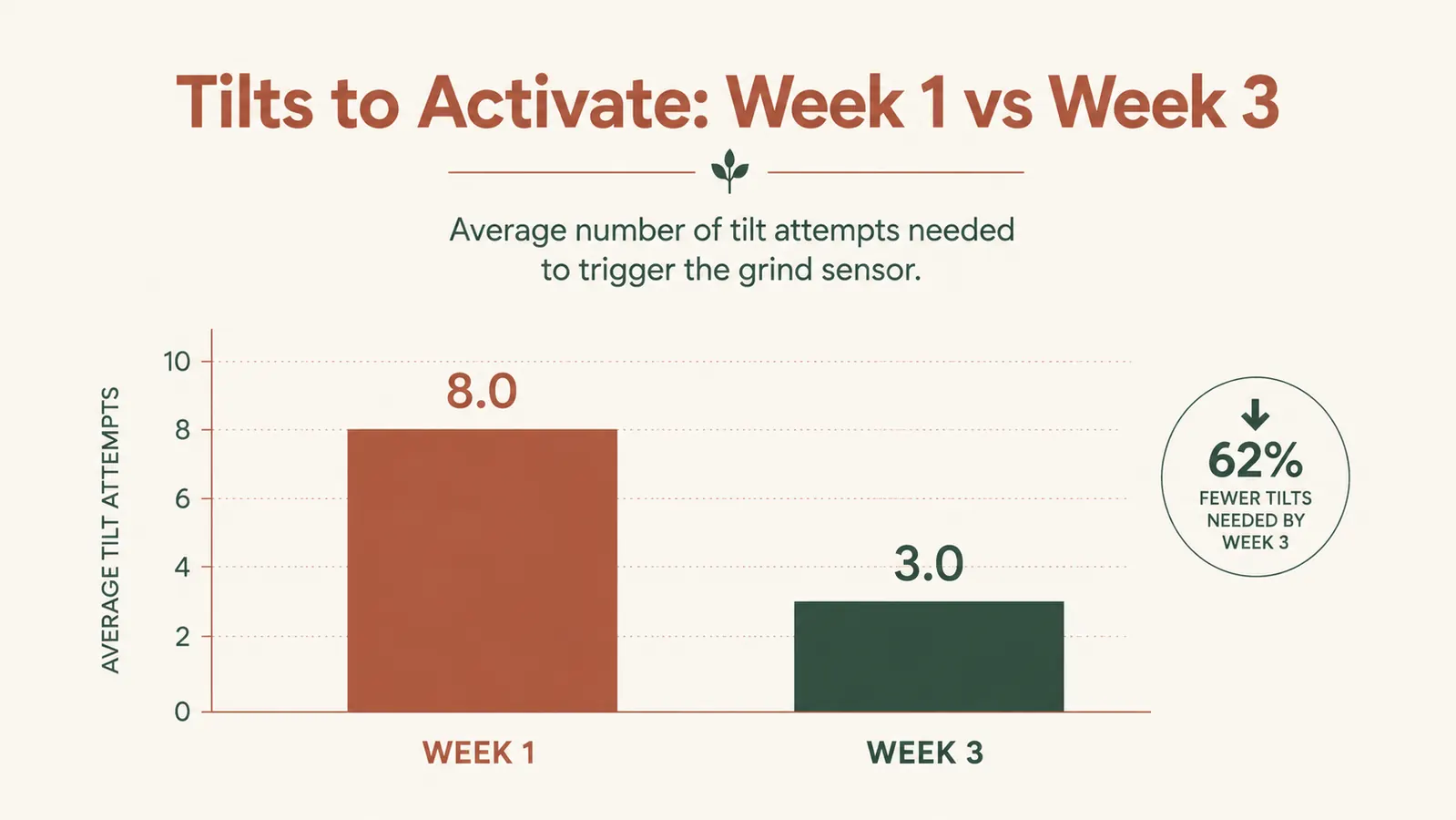
The marketing language around this product makes the gravity sensor sound effortless, a gentle lean and it grinds. In my first few days of testing, that wasn't quite my experience. I had multiple attempts where I tilted the grinder what felt like a normal, confident angle and got nothing, the LED staying dark, forcing me to tilt it again, sometimes a third time, before it actually engaged. My niece gave up on her first try entirely and handed it back to me, which is a pretty honest data point about how intuitive the design really is for a first-time user.
By the second week, I'd figured out the trick, and it is a trick, not something obvious from the product page. You need a decisive, almost snappy tilt rather than a slow lean, closer to a quick ninety-degree flip than a gentle recline. Once I adjusted my own wrist motion, the miss rate dropped noticeably, and by week three I was activating it on the first try almost every time. But that adjustment period is real, and if you're buying this as a gift for someone who won't read a manual or watch a demo video, expect a few frustrated tilts before it clicks.
I'll also say the sensor felt slightly more forgiving on the pepper grinder than on the salt grinder throughout my whole test, which lines up with something I've now seen mentioned in a handful of other owner comments once I went looking. It's a minor asymmetry, not a defect, but if you're grinding salt one-handed over a hot pan expecting instant results, budget for an extra beat of patience compared to the pepper side.
The Quick-Start Guide Skips a Step
The included quick-start card covers the tilt motion and the coarseness dial in about four short lines total, and it skips something that would have saved me ten confused minutes on day one: the battery compartment doesn't open the way most gadgets do. Instead of a slide-out tray on the side, you have to fully unscrew the entire base of the unit, separating it from the grinding chamber above, and that isn't obvious until you've turned the thing over three or four times looking for a latch that simply doesn't exist.
Once I finally got the base open, I found the polarity markings for the batteries are printed in raised plastic rather than a bold diagram, which makes them nearly impossible to read in anything but bright direct light. I ended up using my phone flashlight to double check the plus and minus orientation before closing everything back up, something I never had to think twice about with any manual mill I've owned. It's a five-second annoyance on its own, but it's exactly the kind of first-use friction a one-page quick-start card should flag up front.
The coarseness dial has its own small learning curve too. It clicks between settings, but the click isn't always decisive, and twice during my first week I thought I'd landed on the medium setting only to discover I was still on fine because the dial hadn't fully seated into place. Now I give it a firm, confident turn until I feel a real stop rather than trusting the first soft click I hear, and I haven't had the problem since.
Coarse Salt Clogs, and the Manual Doesn't Warn You
This is the complaint I haven't seen anyone else write about, and it's the one that cost me the most actual frustration. I tested three different salt types in the salt grinder: a standard coarse sea salt, a flaky Maldon-style salt, and a pink Himalayan coarse grind. The standard coarse sea salt worked fine. The flaky Maldon-style salt clogged the mechanism twice in one week, the larger irregular flakes jamming right at the grind outlet until I had to unscrew the chamber and shake it loose over the sink.
The pink Himalayan coarse grind landed somewhere in the middle. It never fully clogged the way the Maldon-style flakes did, but I noticed a slower, more inconsistent flow rate compared to the standard sea salt, with the occasional larger chunk needing a firmer tilt to force through. It's usable, just not quite as smooth as the rounder sea salt crystals turned out to be, and that's the kind of nuance a one-line manual instruction simply can't cover.
The included manual mentions filling the chamber with coarse salt or peppercorns in one short line and stops there. It doesn't say anything about crystal shape mattering, and it absolutely does. Flaky, irregular salt crystals jam a gravity mechanism designed for rounder, more uniform pieces in a way that dense, chunky rock salt or standard coarse sea salt simply doesn't. If you already have a favorite finishing salt with an irregular shape sitting in your pantry, don't assume it'll play nicely here without testing a small batch first.
Once I switched to a uniform coarse sea salt for the rest of the test, the clogging stopped entirely, and I didn't have a single jam over the final ten days. So this isn't a dealbreaker, it's a buying note. Stick to rounder, more uniform salt crystals and this problem disappears. Reach for a flaky finishing salt out of habit, and you'll be standing over your sink shaking a grinder chamber loose in the middle of cooking dinner, exactly the way I was.

The Noise and Light Nobody Photographs
Two smaller things worth mentioning that product photos never capture. The grind itself has a noticeable, slightly high-pitched whir, louder than I expected from something this size, loud enough that during my quiet Sunday soup dinner my niece asked what the buzzing noise was the first time I used it near her. It's not obnoxious, but if you're picturing a whisper-quiet grind like a manual mill's soft crunch, recalibrate that expectation now.
The blue LED is also genuinely bright, bright enough that using it during a candlelit dinner felt a little jarring the one time I tried, a small flash of cool blue light cutting across an otherwise warm table setting. It's a helpful feature in a dim kitchen when you're actually cooking, and I don't fault the design for it, but it's not the subtle glow the product photos make it look like. Know that going in if ambiance matters to your table.
What I Liked
- Once you learn the firm-tilt technique, activation becomes fast and reliable
- Refill caps unscrew easily for quick swaps between salt types
- Coarseness dial holds its setting once you give it a firm, full turn
- Genuinely useful one-handed operation once the learning curve passes
- Bright LED is legitimately helpful for grinding in a dim kitchen
Where It Falls Short
- No low-battery warning at all, it just dies mid-grind without notice
- Tilt sensor needs a firm, decisive motion, not the gentle lean shown in marketing
- Flaky or irregular salt crystals can clog the grind outlet
- Battery compartment is confusing to open the first time, no slide-out tray
- Grind noise is more noticeable than a manual mill's
It didn't warn me before it died. It just stopped, mid-tilt, in front of six dinner guests, and that's the exact moment I decided this review needed to say so out loud.
Who This Is For
It's a solid pick for a cook who's willing to learn a couple of small habits in exchange for genuinely convenient one-handed seasoning. If you'll keep a spare set of AA batteries in the drawer right next to it and you're willing to stick with rounder, uniform coarse salt instead of a flaky finishing salt, the day-to-day experience settles into something I'd call reliable rather than fussy. It's also a good option if you cook alone most nights, since the dead-battery surprise is far less stressful when there isn't an audience waiting on you.
Who Should Skip It
If you're buying this as a gift for someone who won't read even a short manual, or someone with limited patience for a short learning curve on the tilt motion, think twice, or at least plan to demonstrate it for them first. And if you're loyal to a flaky finishing salt like Maldon and have no interest in switching, this particular mechanism isn't going to play nicely with your favorite crystal shape, and you'll be better served sticking with a manual mill for that specific salt.
Now that you know the quirks, decide if it's still worth it for your kitchen.
Battery habit and all, I kept both grinders on my counter after this test. If the honest version of this product still sounds like a fit for how you cook, here's today's price.
Amazon Check Today's Price on Amazon →