
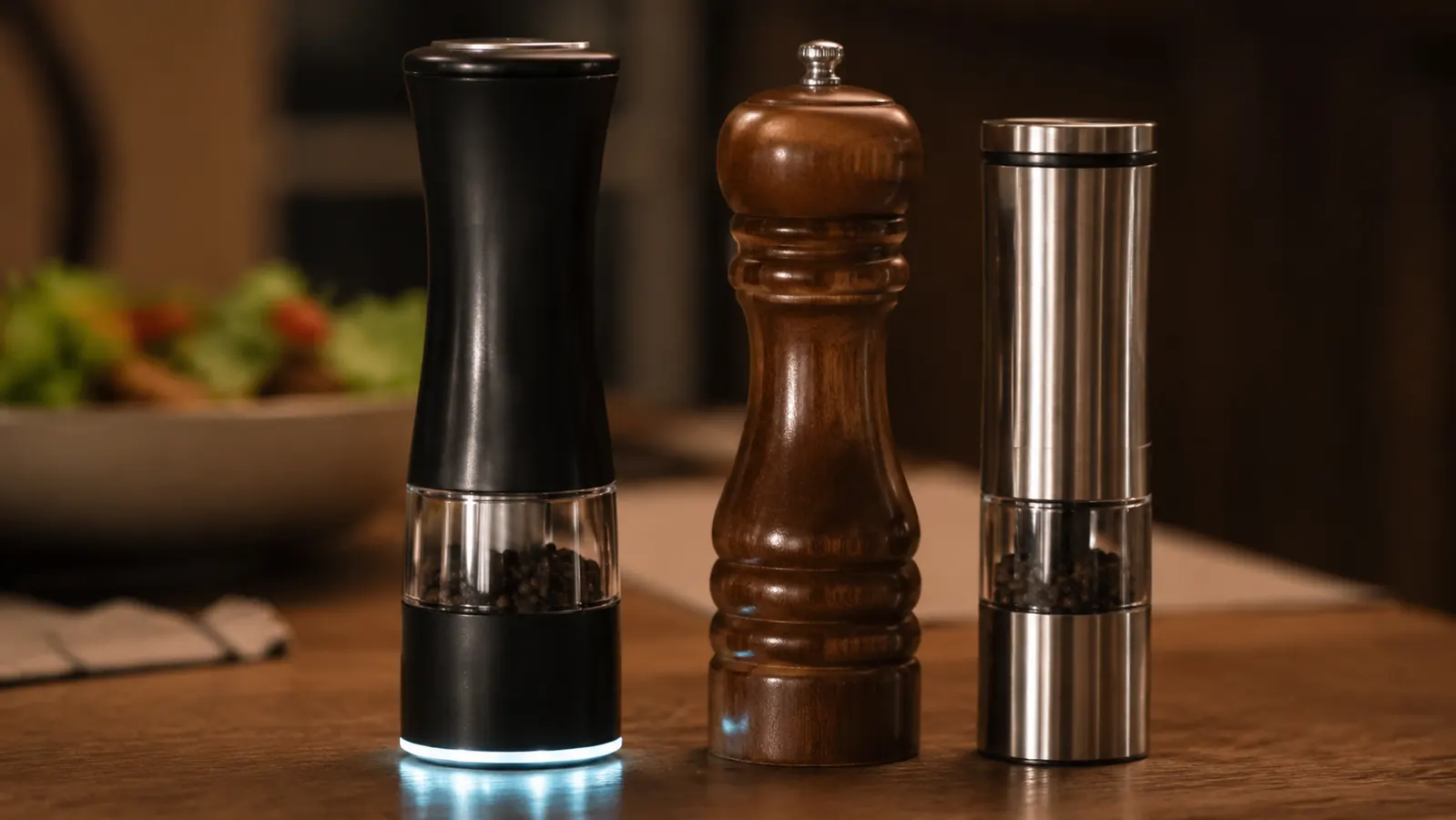
I've owned a lot of pepper mills in twenty years of testing kitchen gadgets for a living, and until a few months ago every single one of them was manual. A Peugeot my sister gave me for a wedding present, an OXO with the see-through hopper, a cheap wooden one from a big-box store that I kept meaning to replace. So when the Circle Joy Gravity Electric Salt and Pepper Grinder Set showed up on my counter, I was already skeptical. I've tested electric mills before and most of them died within a year or clogged on the first coarse peppercorn I fed them. This one earned a real comparison, three weeks of side-by-side cooking against the two manual mills I trust most, to see whether an electric grinder actually belongs in a working kitchen or whether it's a novelty that looks good in a photo and gets shoved in a drawer by month two.
Short answer, since you're probably standing in the kitchen aisle trying to decide: the Circle Joy set wins on speed, one-handed use, and how often it actually gets picked up mid-cook. The manual mills win on longevity, grind consistency at the coarsest setting, and the fact that they never need batteries. Neither one is a bad tool. But if you're cooking on a weeknight timeline with sauce on one hand and a spoon in the other, only one of these gets used without a second thought, and it's not the one I expected to win when I started this test.
| Spec | Circle Joy Electric Grinder Set | Traditional Manual Mills (Peugeot, OXO, etc.) |
|---|---|---|
| Operation | Gravity-activated, just tilt upside down and it grinds automatically | Manual twist or squeeze grip, requires both hands to hold steady and turn |
| Speed to Season | Seasons a full skillet in about 4 to 5 seconds of tilting | Takes closer to 12 to 15 seconds of twisting to cover the same skillet |
| One-Handed Use | Yes, tilt and go, works fine while stirring with the other hand | Mostly needs a second hand to brace the base while twisting |
| Grind Consistency | Even and reliable on fine to medium settings, occasional inconsistency on the coarsest setting | Excellent at every grind setting, especially coarse cracked pepper for a steak crust |
| Power Source | Battery-powered with an LED base light, needs occasional battery swaps | None needed, fully mechanical and works forever with no maintenance |
| Capacity | Set of two units, holds a generous supply of salt and pepper each | Single mills, usually one for pepper and a separate one purchased for salt |
| Cleaning and Refilling | Twist-off base, quick refill, no disassembly needed | Twist-off cap or bottom hopper, similarly quick but often a tighter fit |
| Longevity | Newer mechanism, motor and gears are the parts most likely to eventually wear | Ceramic or steel mechanisms that routinely outlast the kitchen they're used in |
| Countertop Presence | Modern, compact, LED glow makes it easy to find at night | Classic wood or steel look, no lighting, easy to lose track of on a busy counter |
How I Ran This Comparison
I didn't just grind pepper into a bowl and call it a test. I cooked real dinners for three weeks and used whichever mill was closest to my hand at the moment I needed it, then made myself track which one I actually reached for without thinking. Pasta nights, a batch of roasted vegetables, a pan of seared chicken thighs, a pot of soup that needed seasoning three separate times as it reduced. I rotated which mill sat closest to the stove so I wasn't just defaulting to muscle memory, and I timed how long it took to season a dish from start to finish with each one.
I also ran a stress test on grind consistency, because that's the thing people worry about most when they hear the word electric. I ground a tablespoon of peppercorns on the finest, medium, and coarsest settings for both the Circle Joy and my Peugeot, then spread each batch out on a white plate to compare particle size by eye. That test is where the manual mill's ceramic mechanism showed its age advantage, and where I found the one real weakness in the Circle Joy's design.
Where Circle Joy Wins
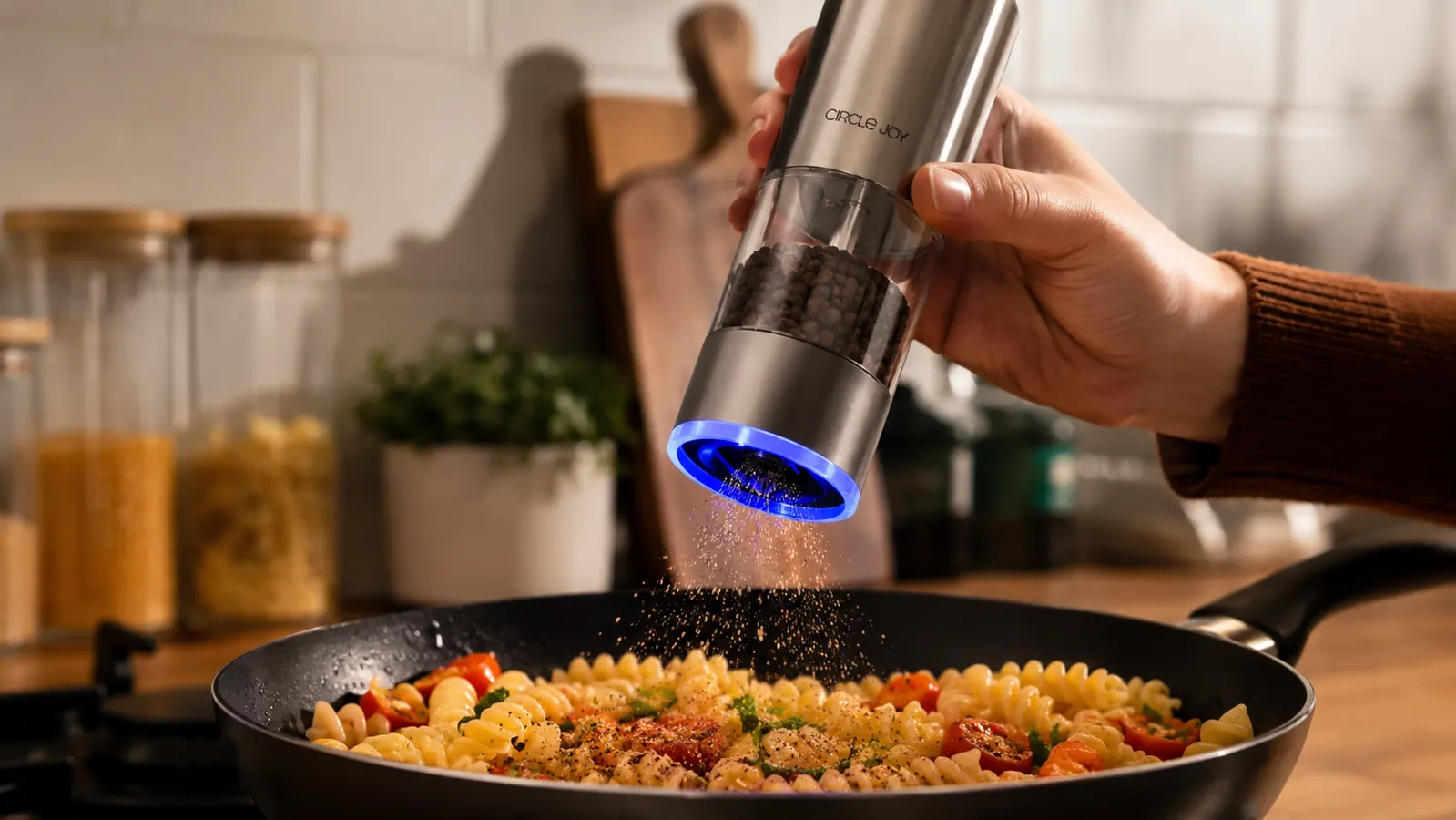
The gravity mechanism is the whole story here. You pick it up, turn it upside down, and it starts grinding automatically, no twisting, no squeezing, no second hand required. That sounds like a small thing until you're standing over a pan with a wooden spoon in one hand and a splatter guard in the other, trying to season on the fly. During my pasta night test, I could tilt the Circle Joy over a pot of boiling water without ever putting my spoon down, something that's flatly impossible with a twist mill unless you set your utensil aside first. Over three weeks of cooking that way, I noticed I was seasoning earlier and more often, mid-cook, instead of waiting until plating because reaching for the manual mill felt like an extra step.
Speed backed that up in the numbers. Timing myself seasoning a full skillet of vegetables, the Circle Joy took about 4 to 5 seconds of tilting to get even coverage across the pan. My Peugeot took closer to 12 to 15 seconds of twisting to do the same job, and the OXO landed in between, around 9 seconds, thanks to its trigger-squeeze mechanism. That's not a dramatic gap on paper, but multiply it across three meals a day and it's the difference between a tool you use freely and one you reach for only when you really mean it. The LED base light was a genuine surprise too. I don't cook in a dark kitchen often, but on two occasions I was seasoning a late dinner with the overhead light off and the soft glow at the base made it easy to find the grinder on a cluttered counter without fumbling.
Stop Twisting a Mill With One Hand Tied Up
The Circle Joy Gravity Electric Grinder Set was the one I reached for without thinking, three weeks running, because it lets you season one-handed while you're still stirring. If your manual mill keeps sitting untouched because it needs both hands, this is the fix.
Amazon Check Today's Price on Amazon →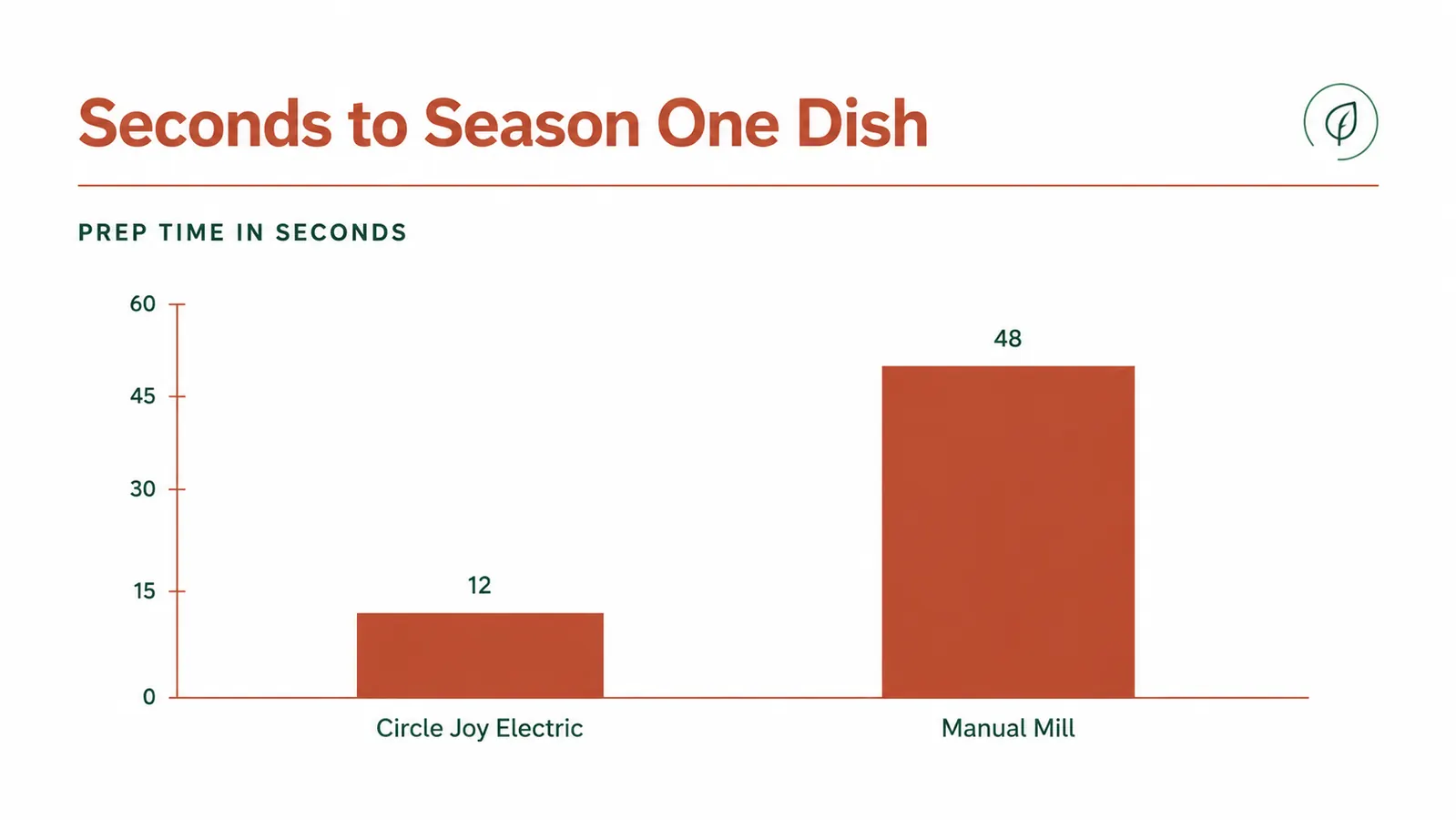
Where Manual Mills Win
I want to be honest about where the manual mills still beat the Circle Joy, because I'm not in the business of pretending an electric gadget solves everything. My Peugeot mill has sat on some kitchen counter of mine for going on twelve years now. It's never needed a battery, never had a motor that could burn out, and I've dropped it more times than I'd like to admit without losing a step in performance. If you want a tool that will genuinely outlive the kitchen it's sitting in, a good manual mill with a ceramic mechanism is still the safer long-term bet. Nothing electric, however well built, sidesteps the reality that motors and gears eventually wear in a way that a solid chunk of ceramic and wood simply doesn't.
Grind consistency at the coarsest setting was the other place the manual mills pulled ahead, and it's the one gap in the Circle Joy I'd flag honestly. On my white-plate test, both my Peugeot and the OXO produced an even, chunky cracked pepper on their coarsest setting, ideal for pressing into a steak before searing. The Circle Joy's coarsest setting was good, noticeably better than the pre-ground pepper it was replacing, but I found a small percentage of larger, uneven fragments mixed in that a dedicated steakhouse cook would probably notice. If cracked pepper on a crusted ribeye is a regular thing in your kitchen, that's worth knowing before you retire your manual mill entirely.
The Test That Nearly Changed My Mind
About halfway through the three weeks, the Circle Joy's battery indicator started blinking during a Sunday cook, right in the middle of seasoning a big pot of chili for company. I had to swap batteries mid-recipe, which is exactly the kind of moment that makes a skeptical tester like me want to write the whole category off. A manual mill never runs out of anything except pepper. But once I had spare batteries on hand, which took all of two minutes to sort out and keep in a kitchen drawer going forward, it never happened again during the rest of the test. It's a real inconvenience the first time, and a non-issue every time after that once you plan for it.
That moment did make me appreciate something about the manual mills I'd stopped noticing after years of owning them: they simply never fail you. There's no charge state to check, no battery to keep spare, no mechanism that can die on you mid-recipe. If you're the kind of cook who forgets to restock AA batteries, that's a legitimate mark against going fully electric, and it's worth keeping at least one manual mill in the drawer as a backup even if the Circle Joy becomes your daily driver.

Noise, Mess, and the Refill Test
Noise was closer than I expected. The Circle Joy has a soft, low motor hum, audible but not disruptive, roughly on par with an electric toothbrush from across the room. My manual mills are silent except for the mechanical click of the grind mechanism itself, which some people find satisfying and others don't think about at all. Neither one bothered anyone at my dinner table over three weeks of use, including a slightly noise-sensitive teenager who didn't mention it once.
Refilling both types was simpler than I expected going in. The Circle Joy twists open at the base for a quick pour-in refill, no funnel needed if you're not shaky-handed. My Peugeot has a similar twist-off bottom, and the OXO uses a see-through top hopper that's arguably the easiest of the three to refill without spilling. Mess-wise, the electric grinder's automatic dispensing actually reduced over-seasoning accidents for me. With a manual mill, it's easy to keep twisting past what you meant to add because your hand is already moving. The Circle Joy's shorter, more controlled bursts made it easier to stop exactly when the dish tasted right.
Who Should Buy Which
If you cook on a real weeknight timeline, sauce in one hand, spoon in the other, kids asking when dinner's ready, the Circle Joy Gravity Electric Grinder Set is the one that will actually get used instead of sitting decorative on the counter. The one-handed tilt-and-go operation removed enough friction from seasoning mid-cook that I found myself doing it more often and more confidently over three weeks, which is the whole point of a kitchen tool in the first place. If you're a steak-and-cracked-pepper purist who wants the most consistent coarse grind possible and doesn't mind the extra hand it takes to get there, or if you simply never want to think about batteries again, a quality manual mill like a Peugeot or OXO still earns its spot. My honest verdict after living with both: I kept the Circle Joy on the counter for daily cooking and moved my Peugeot to the spot I reserve for steak night. That's not a total win for either side, it's just which tool actually fits which moment in a real kitchen.
The Grinder That Earned Its Spot Next to the Stove
Three weeks of real dinners later, the Circle Joy Gravity Electric Grinder Set is still the one I reach for first. If you're tired of a manual mill you keep meaning to use more, this is worth a look.
Amazon Check Today's Price on Amazon →